STEP INTO SUMMER AT MKA
STEM+ Explorers
JULY 6 - JULY 31 | GRADES 6 - 9
Give your middle schooler the keys to the lab this summer.
experimental techniques + robotics + engineering + 3D printing + laser cutting + + coding + podcasting + architecture + filmmaking + audio engineering + music making + animation
- Air-conditioned rooms
- Seven state-of-the-art laboratories for biology, chemistry, physics, environmental science, and research
- Turf fields
- Robotics labs
- Art and Audio studios
- High-quality athletic facilities
- Recently renovated dining halls and auditoriums
- High-tech computer programs with new Apple MacBooks
9:00 AM - 12:30 PM: Morning Session
Morning Core Courses
Core summer school courses are divided into four strands: experimental techniques, fabrication, engineering, and computational thinking. While every strand will run for the entire four weeks, the weeks are designed to be modular and introduce a new unit each week. Students have the option to take all four weeks in one strand or mix and match strands. All courses will be conducted at two levels - one for lower house students (rising 6th and 7th graders) and one for upper house students (rising 8th and 9th graders).
Morning Electives
In addition to courses, students also have the opportunity to sign-up for arts based electives that are designed to complement the core courses. These electives are designed to be stand alone, one-week courses. Students who are registered for multiple weeks of summer school should choose a different elective each week. These classes will be multi-age learning environments with all grade levels learning together.
Art elective options are:
- Audio Engineering and Music Making
- Podcasting
- Architecture
- Filmmaking, Stopaction Photography, and Animation
12:30 PM- 1:30 PM: Lunch & Recess
Explorers will have an hour lunch for socializing, quiet time, or recess.
1:30 PM- 3:30 PM: Afternoon Design Challenge Questions
Each week students will be faced with a new question and will spend the week working collaboratively to develop a solution. The week will begin with an afternoon field trip that introduces the week’s question and will end with a community celebration of all of the students' work. Morning classes will develop the knowledge and skills the students will need to address the afternoon challenge. Students will be placed in groups that span all grade levels.
Week 1: Your community is built on the shore of a river that floods every season. How can you help your community adapt to the rising water levels?
Week 2: Your community doesn't have a clean water supply. The only water available is polluted. How can you make this water safe to drink?
Week 3: Your community experiences long periods of extremely cold weather. What adjustments can you make to keep everyone alive?
Week 4: You are part of the first landing party on Mars. How can you make the planet a place where people can live and thrive?
READY TO EXPLORE?
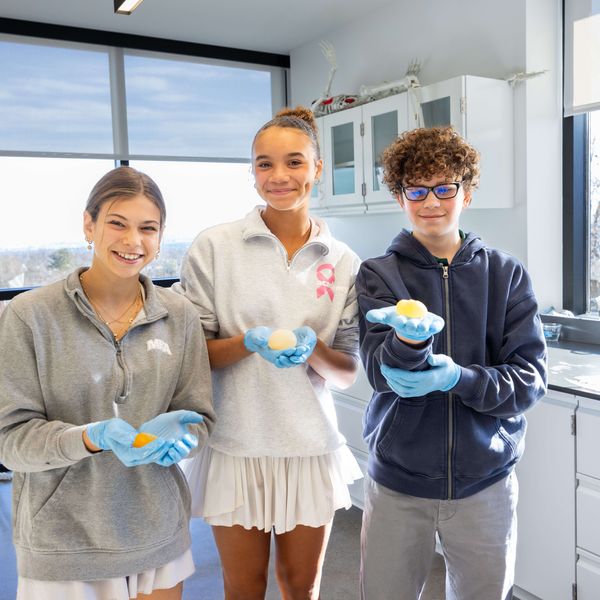
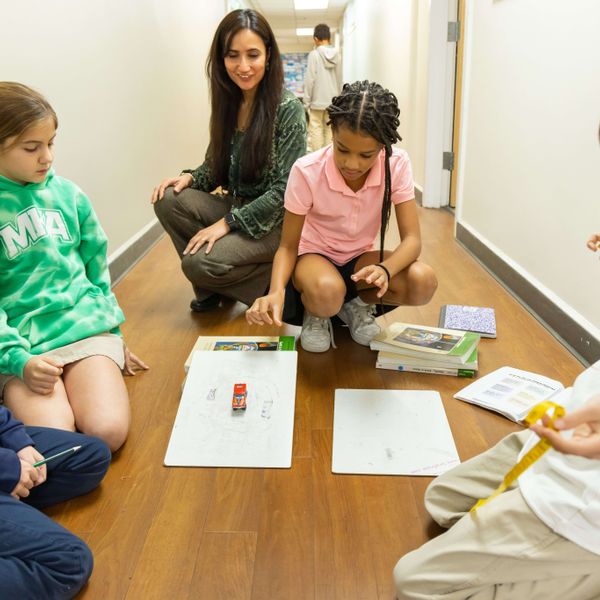
STEM+ Explorers summer program empowers young thinkers to explore the world through the lens of innovation. With hands-on STEM activities led by passionate instructors, campers build skills, confidence, and a love of discovery that lasts long after summer ends.
Each week students will be faced with a new question and will spend the week working collaboratively to develop a solution. Morning classes will develop the knowledge and skills the students will need to address the afternoon challenge.
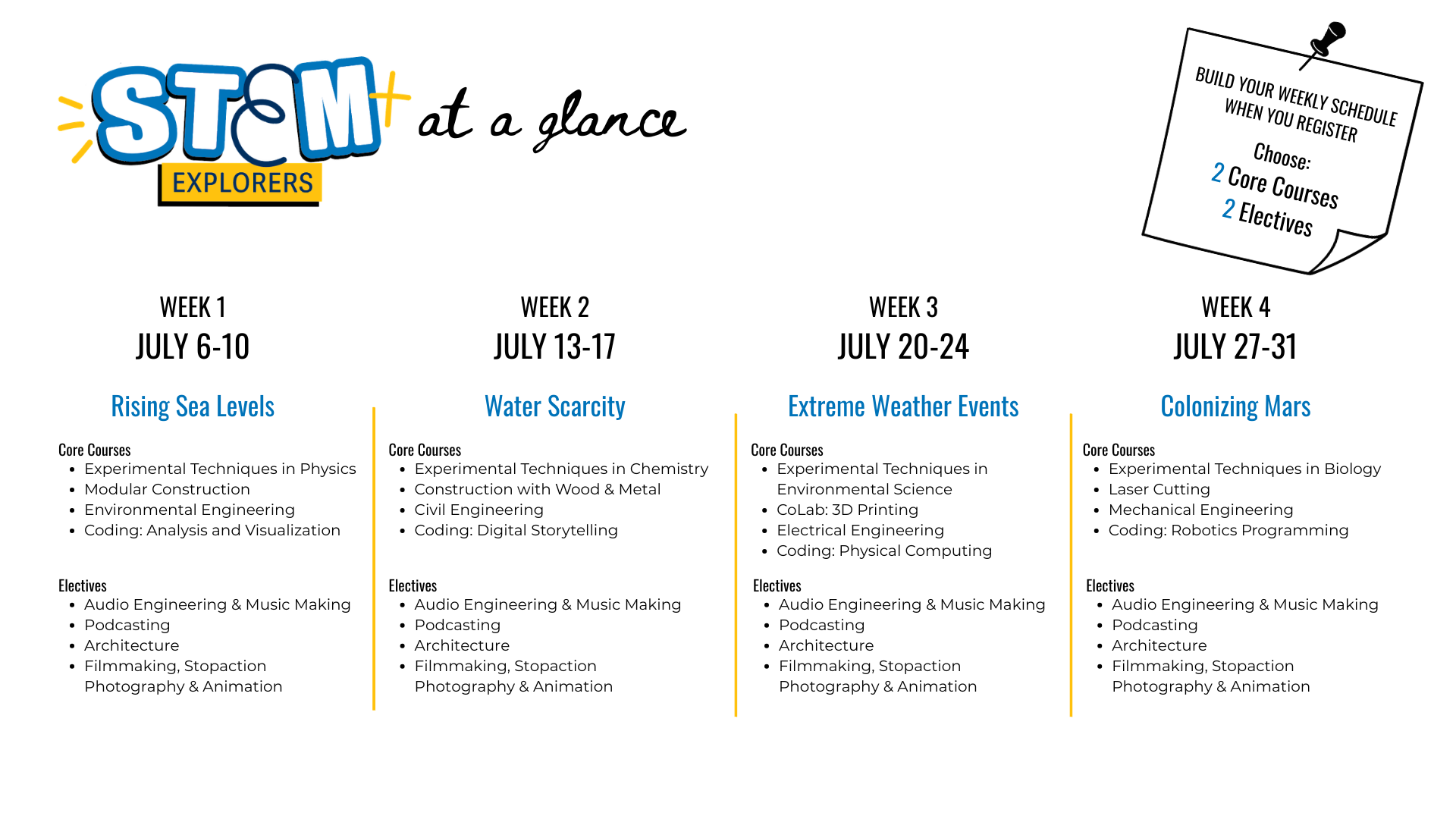
COURSE DESCRIPTIONS
July 6 - July 10
Week 1: Core Courses
Experimental Techniques in Physics
Students will develop the skills needed to make quantitative observations and collect precise data. They will use a variety of sensors such as timers, motion detectors, force sensors to investigate fundamental concepts of motion, forces, and energy.
Modular construction
Students explore principles of building and measurement using modular building materials such as Legos, K’Nex, and straw connectors, and scaffolded building tools
Environmental Engineering
Students become environmental engineers as they explore how water moves, how it can be diverted, and how it is distributed. They’ll investigate the effects of flooding on topsoil, groundwater, and human made structures, and they’ll identify ways to mitigate flooding.
Coding: Analysis & Visualization
Students encounter data related to rising seas and use analytic and algorithmic strategies to make meaning. They will code programs to automate analysis and generate visualizations to help communicate their findings.
Week 1: Electives
Explorers participating in multiple weeks should select a different elective each week.
Podcasting
This one week elective course will introduce students to the basics of podcasting. They’ll explore the key elements of creating an engaging podcast from understanding the audience to telling a compelling story. Students will get hands-on experience writing a script and recording and editing their product.
Architecture
Students will develop an understanding of the art and science of architecture and they will explore basic design principles. They will gain experience with perspective drawing and three-dimensional thinking. Students will use the design thinking process to create and build models using materials such as cardboard and balsa wood.
Filmmaking/Stop Motion/Animation
This course provides students with experience using image capture devices from iPads to DSLRs. They’ll learn narrative and documentation strategies to communicate through video and moving pictures, and they’ll gain editing and mastering skills using Adobe Express and Premier.
Audio Engineering/Music Making
Whether you consider yourself a musician or not, you can make incredible audio worlds using only an iPad. Armed with GarageBand and Sound Trap students will learn to capture and create audio and edit them into brand new works of art.
Afternoon Design Challenge
Each week students will be faced with a new question and will spend the week working collaboratively to develop a solution. The week will begin with an afternoon field trip that introduces the week’s question and will end with a community celebration of all of the students' work. Morning classes will develop the knowledge and skills the students will need to address the afternoon challenge. Students will be placed in groups that span all grade levels.
Week 1: Your community is built on the shore of a river that floods every season. How can you help your community adapt to the rising water levels?
July 13 - July 17
Week 2: Core Courses
Experimental Techniques in Chemistry
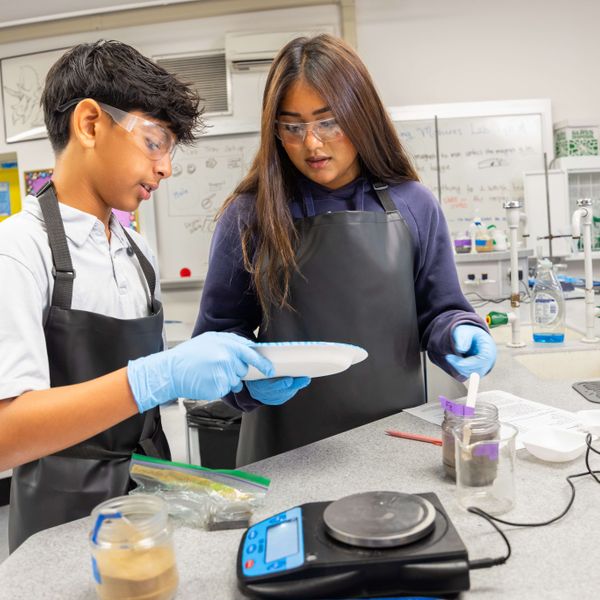
Students will explore states of matter and they will measure physical properties of matter. They will define mixtures, investigate their characteristics and experiment with various separation techniques.
Construction with wood and metal.
Students start week two learning to make accurate engineering drawings for wood and metal construction. Using precise measurements and hand and power tools students bring their drawings to reality.
Civil Engineering
Among the most essential roles of civil engineers is securing clean drinking water. From filtering rainwater and natural sources, to reclaiming used water, students will explore methods of making water potable.
Coding: Digital Storytelling
Exploring the parallels between programming sequence and syntax and the arc of a story, students will use coding platforms to represent data visualizations.
Elective Courses
Explorers participating in multiple weeks should select a different elective each week.
Podcasting
This one week elective course will introduce students to the basics of podcasting. They’ll explore the key elements of creating an engaging podcast from understanding the audience to telling a compelling story. Students will get hands-on experience writing a script and recording and editing their product.
Architecture
Students will develop an understanding of the art and science of architecture and they will explore basic design principles. They will gain experience with perspective drawing and three-dimensional thinking. Students will use the design thinking process to create and build models using materials such as cardboard and balsa wood.
Filmmaking/Stop Motion/Animation
This course provides students with experience using image capture devices from iPads to DSLRs. They’ll learn narrative and documentation strategies to communicate through video and moving pictures, and they’ll gain editing and mastering skills using Adobe Express and Premier.
Audio Engineering/Music Making
Whether you consider yourself a musician or not, you can make incredible audio worlds using only an iPad. Armed with GarageBand and Sound Trap students will learn to capture and create audio and edit them into brand new works of art.
Afternoon Design Challenge
Each week students will be faced with a new question and will spend the week working collaboratively to develop a solution. The week will begin with an afternoon field trip that introduces the week’s question and will end with a community celebration of all of the students' work. Morning classes will develop the knowledge and skills the students will need to address the afternoon challenge. Students will be placed in groups that span all grade levels.
Week 2: Your community doesn't have a clean water supply. The only water available is polluted. How can you make this water safe to drink?
July 20 - July 24
Week 3: Core Courses
Experimental Techniques in Environmental Science
Students will investigate and model complex environmental systems. They will practice sample collection and make field measurements to gather data.
3D Printing
Using Tinkercad as their platform, students explore 3D modeling and design. Starting with basic shapes, they’ll modify dimensions, position, and rotation, and they’ll combine their shapes to make complex objects to be 3D printed, evaluated, and improved.
Electrical Engineering
Understanding fundamentals of electricity creates a foundation for innovation. Students will use switches, motors, lights, and other electrical elements to invent new devices and solutions to problems connected to low temperature.
Coding: Physical Computing (MaKey MaKey/Raspberry Pi)
Extending programming interfaces to the physical world allows students to develop innovations that are meaningful and specific. During this week students will write programs to operate physical computing devices using MaKey MaKey and Raspberry Pi.
Elective Courses
Explorers participating in multiple weeks should select a different elective each week.
Podcasting
This one week elective course will introduce students to the basics of podcasting. They’ll explore the key elements of creating an engaging podcast from understanding the audience to telling a compelling story. Students will get hands-on experience writing a script and recording and editing their product.
Architecture
Students will develop an understanding of the art and science of architecture and they will explore basic design principles. They will gain experience with perspective drawing and three-dimensional thinking. Students will use the design thinking process to create and build models using materials such as cardboard and balsa wood.
Filmmaking/Stop Motion/Animation
This course provides students with experience using image capture devices from iPads to DSLRs. They’ll learn narrative and documentation strategies to communicate through video and moving pictures, and they’ll gain editing and mastering skills using Adobe Express and Premier.
Audio Engineering/Music Making
Whether you consider yourself a musician or not, you can make incredible audio worlds using only an iPad. Armed with GarageBand and Sound Trap students will learn to capture and create audio and edit them into brand new works of art.
Afternoon Design Challenge
Each week students will be faced with a new question and will spend the week working collaboratively to develop a solution. The week will begin with an afternoon field trip that introduces the week’s question and will end with a community celebration of all of the students' work. Morning classes will develop the knowledge and skills the students will need to address the afternoon challenge. Students will be placed in groups that span all grade levels.
Week 3: Your community experiences long periods of extremely cold weather. What adjustments can you make to keep everyone alive?
July 27 - July 31
Week 4: Core Courses
Experimental Techniques in Biology
Students will discuss the importance of experimental design, emphasizing the importance of developing testable questions with clearly defined variables. They will become comfortable using a variety of tools including a scale and microscope.
Laser Cutting
Students use Cuttle and Adobe Illustrator to create vector images and 2D objects. They’ll design interlocking/interconnected elements within a single item, and use the laser cutter to fabricate their designs.
Mechanical Engineering
From simple to complex, students explore machines and how we leverage mechanical advantage. They’ll investigate the ways engineers use materials and machines to make work easier.
Coding: Robotics Programming
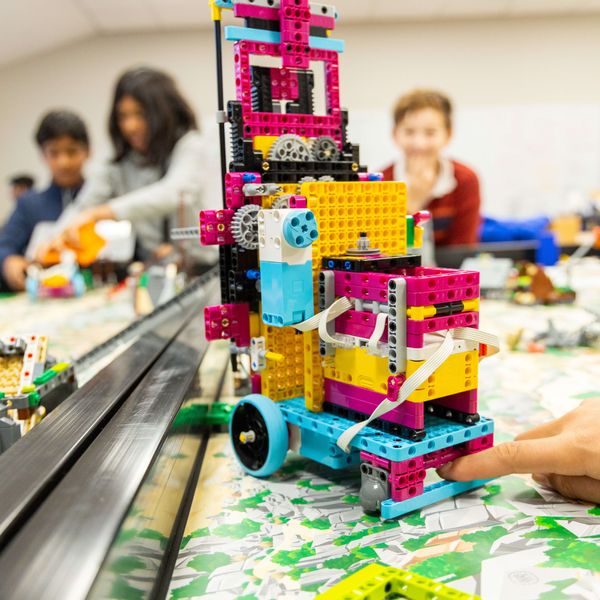
At the nexus of programming and engineering lies robotics. Students will learn to program robots to achieve tasks, and they will design and construct robots to help humans colonize Mars.
Elective Courses
Explorers participating in multiple weeks should select a different elective each week.
Podcasting
This one week elective course will introduce students to the basics of podcasting. They’ll explore the key elements of creating an engaging podcast from understanding the audience to telling a compelling story. Students will get hands-on experience writing a script and recording and editing their product.
Architecture
Students will develop an understanding of the art and science of architecture and they will explore basic design principles. They will gain experience with perspective drawing and three-dimensional thinking. Students will use the design thinking process to create and build models using materials such as cardboard and balsa wood.
Filmmaking/Stop Motion/Animation
This course provides students with experience using image capture devices from iPads to DSLRs. They’ll learn narrative and documentation strategies to communicate through video and moving pictures, and they’ll gain editing and mastering skills using Adobe Express and Premier.
Audio Engineering/Music Making
Whether you consider yourself a musician or not, you can make incredible audio worlds using only an iPad. Armed with GarageBand and Sound Trap students will learn to capture and create audio and edit them into brand new works of art.
Afternoon Design Challenge
Each week students will be faced with a new question and will spend the week working collaboratively to develop a solution. The week will begin with an afternoon field trip that introduces the week’s question and will end with a community celebration of all of the students' work. Morning classes will develop the knowledge and skills the students will need to address the afternoon challenge. Students will be placed in groups that span all grade levels.
Week 4: You are part of the first landing party on Mars. How can you make the planet a place where people can live and thrive?
Four, one-week sessions from 8:30 a.m. - 3:00 p.m.
- Week 1: July 6-10
- Week 2: July 13-17
- Week 3: July 20-24
- Week 4: July 27-July 31
STEM + Explorers is $425 for a half day, and $850 for a full day.
- All fees are due with course registration.
- Refunds or credits due to illness or absence during camp will be considered on a case-by-case basis.
- The camp reserves the right, in its sole discretion, to suspend or dismiss any camper if his or her conduct is detrimental to the well-being of the camp or any other camper(s). No refund or credit will be issued.
- Please note that course offerings are subject to minimum enrollment and staff availability
Lunch is not provided for the summer programs, as we ask all learners to bring their own lunch.
We will offer a variety of healthy snacks for learners to choose from during break times.

MEET OUR TEAM
Petra Sauer, Ph.D., Director of STEM+ Programming (9-12), Upper School Science Faculty
Chris McLaughlin, Director of STEM+ Programming (Jr-K–8)
Monica Masterson, Director of Summer Operations, (4-8)
EMPLOYMENT OPPORTUNITIES
Interested in a summer opportunity? Contact Monica Masterson.
FAQ
Questions? For general questions, please email mkasummer@mka.org or read more on our FAQ page.
STAYING A FULL DAY?
Afternoon Design Challenge
Each week, students registered for full day programming will be faced with a new question and will spend the week working collaboratively to develop a solution.

Week 1: Rising Sea Levels
Week 1: Rising Sea Levels
Your community is built on the shore of a river that floods every season. How can you help your community adapt to the rising water levels?

Week 2: Water Scarcity
Week 2: Water Scarcity
Your community doesn't have a clean water supply. The only water available is polluted. How can you make this water safe to drink?

Week 3: Extreme Weather Events
Week 3: Extreme Weather Events
Your community experiences long periods of extremely cold weather. What adjustments can you make to keep everyone alive?

Week 4: Colonizing Mars
Week 4: Colonizing Mars
You are part of the first landing party on Mars. How can you make the planet a place where people can live and thrive?