Doing the Right Thing: A Living History Lesson from the Danish Ambassador
What makes a community do the right thing? Students at The Montclair Kimberley Academy received an unforgettable lesson in the power of standing up to injustice when the Danish Consul General to New York, Ambassador Torben Gettermann, recently spent a morning at the school.
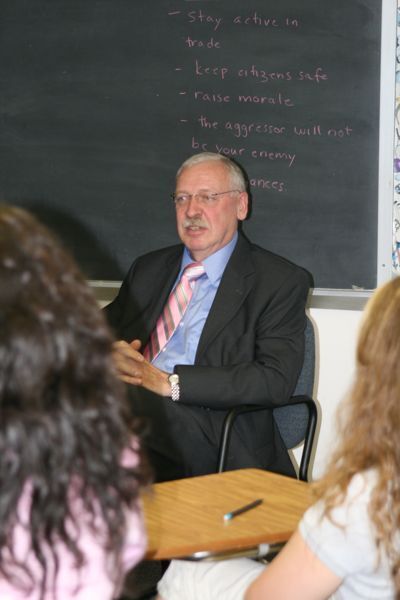
Ambassador Gettermann, whose career has taken him all over the world, including to Saudi Arabia, Hungary, Greece and Iraq, regularly talks to students about the extraordinary story of the Danish people and their rescue of the Danish Jews during the latter days of the Second World War; a story with particular resonance for the Ambassador as his father was a leader in the Danish resistance.
After setting the scene, by explaining the complete assimilation of the Jewish population in Denmark at the time, and the circumstances of the German occupation of Denmark, Ambassador Gettermann described the rise of a resistance movement that began with young teenagers in taking the lead, and ended with an entire nation taking action. Two days after Germany ordered the deportation and incarceration of Danish Jews in the autumn of 1943, thousands of Danes took part in a spontaneous resistance that resulted in the transportation of 7500 of the 8000 Jews living in the country to Sweden.
In a freshman Ethics and Character class, students questioned whether initially surrendering to the German's rather than "fighting back" had made the country a safer place, "A crucial question," noted the Ambassador, and in his presentation to the junior class, recently returned from a trip to Washington that included a visit to the Holocaust museum, the question of why the Danes took such risks to help strangers was raised. "I have been asked that so many times," answered Ambassador Gettermann "They just felt they had to. I don't know if it's a special Danish trait, but standing up against injustice to a fellow Dane became the civilized thing to do."
The morning concluded with a presentation to the entire MKA Middle School, where Head of Campus Dr. Randy Kleinman noted that "It is an honor for us to come together as a community to listen to you." A sea of hands shot up when the Ambassador invited questions of his young audience, questions that ranged from "How did people contact the Jews to help them escape?" to "What's it like being an ambassador?" (Answer: "It's great!") The relevance of this historic lesson to today was also discussed throughout the morning, with particular reference made to its influence on the people of Billings, Montana who resisted hate crimes in 1993. Among the audience was Dr. Janice Cohn, a local psychotherapist and author of The Christmas Menorahs: How a Town Fought Hate a children's bookdescribing that incident (familiar to many of the students). Dr. Cohn, who was instrumental in bringing Ambassador Gettermann to MKA, perhaps best summed up his visit for the MKA community saying, "It was a very special experience."


