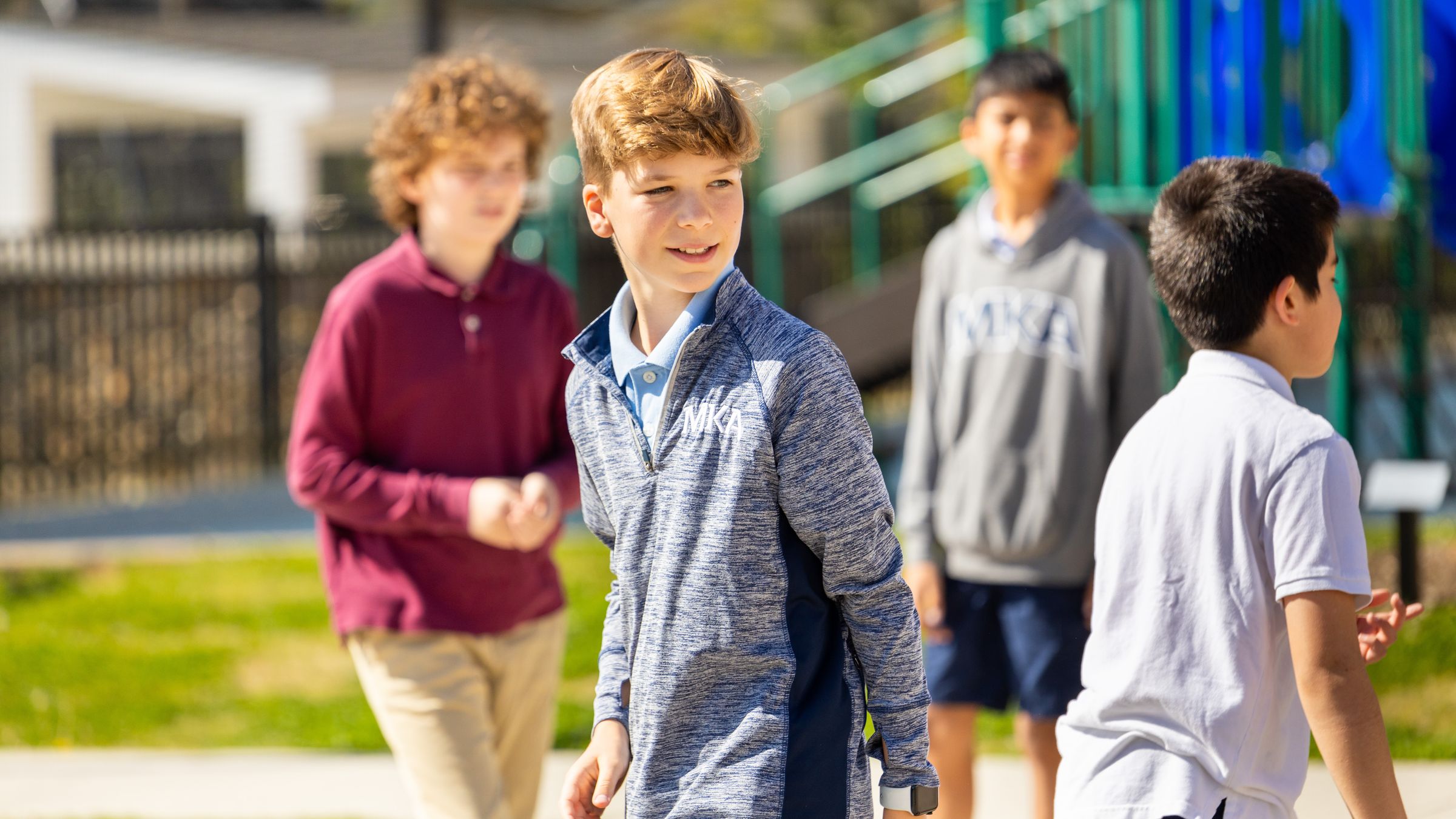
MKA centers students’ health, growth, and happiness. Because true academic success begins with holistic support, the school prioritizes social-emotional learning (SEL) and responsive, student-focused programming from Jr-K through twelfth grade. Purposeful initiatives foster an inclusive environment, empower students’ voices, and build a community where every learner can truly thrive.

Primary School
Primary School
On the Primary School campus, a warm, foundation-building environment ensures young learners feel safe, known, and supported. Proactive social-emotional learning and strong school-family partnerships foster a community where every child builds confidence, empathy, and meaningful connections.

Middle School
Middle School
Our Middle School campus supports students through a transformative period of personal, social, and academic growth. By balancing social-emotional skill-building with a strong sense of belonging, we help emerging adolescents navigate new challenges, develop self-awareness, and make choices they can be proud of.

Upper School
Upper School
Our Upper School campus prepares students for life beyond high school by prioritizing personal agency, mental well-being, and balanced growth. By combining strong mentorship with actionable student feedback, we equip young adults to navigate academic expectations while developing essential, lifelong wellness habits
Responsive Classroom
A student-centered Responsive Classroom framework weaves social-emotional learning into the academic day. It emphasizes building and supporting a community where empathy and accountability thrive, ensuring every student feels valued and connected.
An integral part of the Responsive Classroom program that provides an effective, research-based framework for social and emotional learning, the Morning Meeting also targets academic skill development and reinforces routines that help students initiate and structure their learning.
Students begin each day with a classroom Morning Meeting, one of the most important times of the school day for setting a positive tone for learning and creating a sense of community and belonging. Students and teachers interact with one another through four, purposeful Morning Meeting components: greeting, sharing, group activity, and morning message. In Morning Meetings, classes use the MKA Character Standards, the Primary School Anti-Bullying Standards, and MKA’s Social and Emotional Learning Competencies as guides and are informed by MKA’s Inclusive and Representative Curriculum as they develop classroom expectations in keeping with the guiding Primary School slogan: “We Care. We Are Kind. We Are the Cougars.” These expectations form the basis of students’ social interactions and collaborative learning throughout the day.
Throughout the school day, Primary School students practice the skills that foster community, such as:
- Establishing eye contact;
- Using an audible, friendly tone of voice;
- Demonstrating mutual respect;
- Understanding emotions and using empathy;
- Managing feelings; and
- Fostering friendships.
In second and third grades, Morning Meeting helps students appreciate each other as individuals. Students explore facets of their personal identities and are challenged to think critically about how the nuances of individual identities influence perspective. Through full-group discussion, questions such as “How do our identities develop and change over time?” and “How does our perspective shape the way we view others?” encourage students to reflect on their own experiences and consider how aspects of their identities are similar to and different from others’. Read-alouds are carefully selected to provide students with both mirrors and windows—opportunities to see themselves reflected in stories, as well as to learn about the experiences of others.
Cultivating Calm and Connection
Every learning space is thoughtfully equipped with calm corners and feeling charts, ensuring students have the tools to navigate their emotions with confidence. During student-led community meetings for the whole Primary School, the atmosphere remains vibrant and grounded through intentional, shared-breathing exercises and mind-and-body energizers.
Intentional Support for Building Social Connections
Counselor-led lunch bunches are one way that we provide a supportive environment where students refine their ability to collaborate and build meaningful connections. By offering tailored guidance in emotional regulation and interpersonal dynamics, we empower students to navigate their social world with the resilience and self-assurance essential for lifelong success.
Student Affinity Groups
Our school takes great pride in hosting student affinity groups, creating intentional spaces for members of shared identities to connect, reflect, and find mutual support. These groups serve as a vital cornerstone of our community, fostering a deep sense of belonging and psychological safety that allows participants to feel truly seen and heard. By nurturing these unique bonds, we strengthen the collective fabric of our school and empower students to lead with authenticity and pride.
Parent Education
Our campus hosts a comprehensive Parent Education Series, often featuring insightful talks led by members of the Primary School Administrative Team and our dedicated Student Support team. In addition, we frequently invite outside experts and guest speakers to share their specialized knowledge. These sessions ensure parents are fully informed and aligned with the Primary School’s approach to supporting every child's development.
Advisory Program
Every student is paired with an advisor in a small, dedicated group setting. Advisory serves as a low-pressure space where students reflect on their growth, practice intentional goal-setting, build self-advocacy skills, gain confidence in using their voices, and connect with their grade-level community. Through targeted lesson plans, advisors directly help students practice essential social-emotional learning skills rooted in our school’s Character Standards. By embedding values such as integrity, empathy, respect, and responsibility into these guided sessions and helping students integrate them into their personal goals, students actively learn to navigate their academic and personal journeys as mindful, empowered community members.
CORE Competencies
CORE Competencies are the executive functioning skills we teach at MKA: Control, On-Task, Responsibility, and Efficacy. Each department has its own area of focus to help ensure that students are continuously developing these competencies and increasingly able to transfer them across all areas of study—and even beyond the classroom. At the Middle School, we focus primarily on the following Executive Function Skills:
- Self-Monitoring and Reflection
- Planning, Prioritizing, and Goal Setting
- Organization
- Flexible Thinking
- Emotional Regulation, Self-Control, and Decision Making
- Working Memory
- Task Initiation and Time Awareness
- Self-Advocacy
Responsive Classroom
In grades four and five, a student-centered Responsive Classroom framework weaves social-emotional learning into the academic day. It emphasizes grounding and building a community where empathy and accountability thrive, ensuring every student feels valued and connected.
An integral part of the Responsive Classroom program that provides an effective, research-based framework for social and emotional learning, the Morning Meeting also targets academic skill development and reinforces routines that help students initiate and structure their learning.
Students begin each day with a classroom Morning Meeting, one of the most important times of the school day for setting a positive tone for learning and creating a sense of community and belonging. Students and teachers interact with one another through four, purposeful Morning Meeting components: greeting, sharing, group activity, and morning message. In Morning Meetings, classes use the MKA Character Standards, the Primary School Anti-Bullying Standards, and MKA’s Social and Emotional Learning Competencies as guides and are informed by MKA’s Inclusive and Representative Curriculum as they develop classroom expectations in keeping with the guiding Primary School slogan: “We Care. We Are Kind. We Are the Cougars.” These expectations form the basis of students’ social interactions and collaborative learning throughout the day.
Throughout the school day, Primary School students practice the skills that foster community, such as:
- Establishing eye contact;
- Using an audible, friendly tone of voice;
- Demonstrating mutual respect;
- Understanding emotions and using empathy;
- Managing feelings; and
- Fostering friendships.
In second and third grades, Morning Meeting helps students appreciate each other as individuals. Students explore facets of their personal identities and are challenged to think critically about how the nuances of individual identities influence perspective. Through full-group discussion, questions such as “How do our identities develop and change over time?” and “How does our perspective shape the way we view others?” encourage students to reflect on their own experiences and consider how aspects of their identities are similar to and different from others’. Read-alouds are carefully selected to provide students with both mirrors and windows—opportunities to see themselves reflected in stories, as well as to learn about the experiences of others.
Community Time
Intentionally designed opportunities for students to gather in various settings and groupings foster a strong sense of community. Students meet as an entire campus community weekly at assembly, as Advisory groups daily, and in interest and affinity groups weekly to support one another and celebrate our community.
Advisory Program
Designed as a low-pressure, supportive space, Advisory pairs students with a dedicated faculty advisor and a consistent cohort of peers for all four years of their Upper School experience. Weekly advisory meetings offer opportunities to decompress, build strong peer connections, and provide personalized mentorship. Ultimately, Advisory strengthens student well-being while giving families a clear, direct point of connection with the school community.
Wellness Weeks and Mental Health Awareness
Held twice a year, Upper School Wellness Weeks bring the community together to prioritize physical and mental health, destigmatize life's challenges, and foster open dialogue. Focused on critical topics, such as mental health awareness and substance use prevention, these dedicated weeks feature expert guest speakers, interactive programming, and practical strategies. Together, students and faculty gain actionable tools to navigate real-world pressures with resilience, empathy, and mutual support.
Data-Driven SEL
The Upper School regularly measures community well-being through targeted, research-informed surveys. Using the results of the annual Connectivity Survey alongside triennial evaluations from PRIDE and Challenge Success, our administrative and wellness teams track trends surrounding mental health, stress management, substance use, and social belonging. This data enables us to make informed, responsive decisions that strengthen student support across campus.
WELLNESS AND THE MKA LEARNER
At the Primary School
Students are taught the skills and knowledge to live a physically active, healthy life. Activities are designed to enhance each student’s gross motor skills while also strengthening their balance and coordination. Exercise breathing is a technique used to increase endurance and support mental health. Team concepts and team sports have an important place at the Primary School. Students learn the importance of working together to achieve a common goal. Emphasis is placed on fair play while students learn how to handle winning and losing games respectfully.
At the Middle School
The Health and Wellness curriculum evolves with students at every grade level. Throughout their middle school years, students explore the seven components of the Wellness Wheel: mental, emotional, social, physical, spiritual, intellectual, and environmental, and revisit these themes in greater depth. Along the way, students build essential skills related to positive self-talk, emotional awareness, informed decision-making, effective coping strategies, and reflection. These intentional efforts help students uncover their sense of purpose and navigate their place in the world.
At the Upper School
The Health and Wellness curriculum offers engaging learning opportunities. In ninth and tenth grades, students take one semester of Physical Education and Health, with a choice of targeted Physical Education courses designed to help everyone grow and feel confident in an environment that feels both purposeful and safe. Throughout the wellness program, the department addresses key strands in an age-appropriate way, including Mental Health, Substance Use and Addiction, Nutrition, Social Media Literacy, and Consent and Relationships.
Social-emotional learning (SEL), wellness, and academic growth are integrally connected. Research shows that students who attend schools with strong social-emotional learning and wellness programs have higher academic achievement, better mental health, and fewer behavioral difficulties in school, benefits that continue into adulthood.
MKA’s Office of Student Support bridges counseling and academic support, nurturing every aspect of our students' growth and understanding of human complexity in a diverse, collaborative, and inclusive environment. This tri-campus office facilitates student and family programming, promotes cross-campus collaboration, and provides professional development opportunities for MKA employees.